
Off the Grid
Winter Solstice Musings...

Off the Grid
Today is the winter Solstice and over the longest night we had a wild and blustery storm roll in bringing gusts that toppled trees onto power lines and shutting the power off to about 10,000 people in our rural river valley. The irony of the lights going off coinciding with the darkest night of the year here in the northern hemisphere did not escape me. All our community message boards were lit up with people anxiously asking if anyone around them has power, as if sitting with the dark with the lack of electronic communication was too much to bear. So many people crying out into the dark, “anyone? Can you hear me? Please tell me it will all be ok and I will have all the perks of electricity back soon. How will I make coffee this morning?!”
Whenever this happens, I can’t help but smugly smile inwardly knowing that almost 2 decades ago set up the first grid tied, battery backup solar system here in Oregon. So, when the power goes out, I don’t even notice and with Starlink, our internet is uninterrupted as well. Before establishing this homestead, which has 200 amps of grid power available, I had lived on an off grid homestead nearby where we had to generate all of our electricity with solar panels and a micro-hydropower system which used falling water from a nearby steam to generate DC electricity 24/7. At that location we got our domestic water from a gravity water line fed from a mountain spring. The simple life to be sure, which certainly requires lots of not so simple hands-on maintenance. Thankfully this has had the added benefit of developing the knowledge of how to be more self-reliant. When I was establishing this farm, it felt like a step backwards to move back to on the grid living, however, we quickly became accustomed to all the electricity we could use after years of having to ration ourselves based on if the sun was shining, or how much juice we had in our battery pack. We used to have a 1 light on per person rule to conserve electricity and decisions like whether to do a load of laundry or run power tools were everyday occurrences.
So, when Oregon began offering cost-share programs to incentivize homeowners to install solar back in 2004, I jumped at the opportunity to achieve some degree of energy independence once again. We sold our diesel farm truck that we had been running on biodiesel to afford the upfront costs which made sense to us at the time. We still had an old gas hog Ford beater farm truck to help us take care of all the farm tasks. A new inverter had recently been invented which converted DC power to AC that had the technology to balance many power inputs and outputs such as solar, hydro and generator power “in” and home power and “net-metering” which is the term for selling power back to the grid. The solar installer joked that I was installing the most expensive flashlight in the world! The idea of the power going out when I had a solar system and having no power seemed absurd to me, but this is how most of the solar systems that you see on roofs are set up, with no battery backup whatsoever.
Electricity and power more broadly represents a huge blind spot for most people in industrialized nations. We simply assume that the invisible flow of electrons is a God given right and unsurprisingly we are thrown into calamity when its flow is interrupted by natural disasters. Some estimates put our access to power as being the equivalent as each of us having 25 energy slaves at our service. Another way to visualize this, is the power from one horse being equivalent to the motor that powers your washing machine, and another for each power tool you have and another 200+ for your car and so on. Technological progress has most certainly enabled each of us to direct so many of our waking hours to other pursuits. Although, in a twist of irony, so many of us spend this time working for the money to pay for the privileges of power! Personally, I like living closer to the source of the basic needs that support my life. Most people have no clue where their water comes from, where their waste goes, who grows their food, makes their clothes or how to repair the basic tools that they rely upon. This has been a big part of the post-World War II industrial miracle, divorcing us from the land, the seasonal cycles and the sources of our substance. No wonder so many people struggle with mental health even though the science repeatedly proves that connection to nature and animals has a hugely beneficial effect upon our mental and emotional well-being.
I have been reading a fascinating biography about the life of Benjamin Franklin by Walter Issacson. Franklin gained wide acclaim for his discovery of electricity and his 1751 invention of the lightning rod. I find it a most beautiful synchronicity that concurrent with his experiments with electricity he was grappling with the philosophical ramifications of independence from Brittan and freedom and liberty. It is not an exaggeration to say he was wielding and harnessing power figuratively and literally. This was a watershed moment for the evolution of civilization which would usher in a torrent of innovation during the industrial revolution such that technological advances directly correlated with the increased standard of living of those who possessed them. The rest is history which bears out the ancient parable, popularized by Marvel cartoonist Stan Lee in the 1956 Spider man comic, “with great power comes great responsibility”.
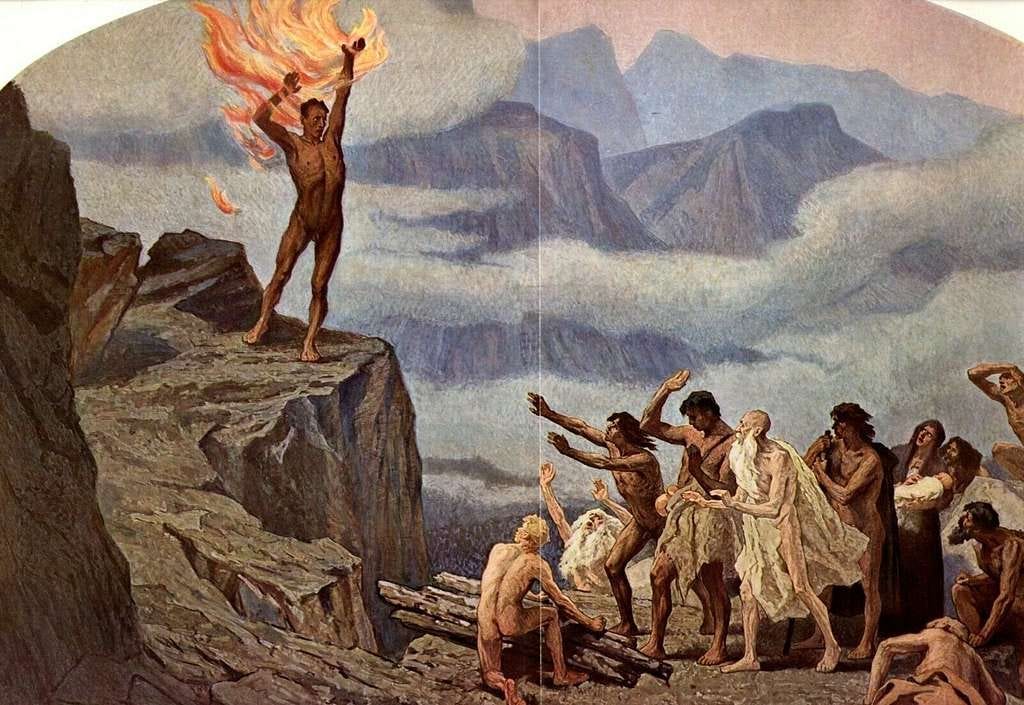
Considering power, I ponder how at the heart of it all, electricity is very much a Promethean process. Somewhere, something is being burned to generate electricity, unless of course you live in an area where hydropower is doing the turbine turning. What we burn is ancient carbon in the form of oil, coal or natural gas, or worse yet uranium mined from deep in the earth. Much like Prometheus, who was a Titan and known as the god of Foresight, who tricked Zeus and stole fire and gave it to humanity, we seem to being paying the price for our stealing fire. Ironically, as the price of stealing fire, and as punishment to humankind in general, Zeus created the woman Pandora and sent her down to Epimetheus (which means Hindsight in Greek), who, though warned by Prometheus, married her. Pandora took the great lid off the jar she carried, and evils, hard work, and disease flew out to plague humanity. Like the cataclysm of opening Pandora’s box, the mining and burning of fossil fuels, has unleashed a fury of problems and challenges for humanity that we are only now figuring out how to grapple with. The entire process is fraught with fragile supply chains, brittle systems, and externalized impacts that cause mayhem when they break.
The phrase “energy descent” began to enter the popular lexicon in the early 2000s during the early Peak oil discussions popularized by the likes of Reichard Heinberg in his book “The Party’s Over” and Permaculture co-founder David Holmgren essay, “Crash on Demand”. It describes a period of declining net energy available to society. The peak oil energy descent model has focused mainly on resource scarcity leading to an involuntary contraction of energy use, euphemistically called “demand destruction”. We did not follow this path. What these peak oil pragmatists failed to consider is that humanities’ immense hunger for power knows no bounds and has led us further into the recesses of Pandora’s box, manifesting as the mining of tar sands, fracking for natural gas, oil shale mining and a rekindled new fascination with nuclear energy, spurred on with the need to power data centers for AI and cryptocurrency mining. All of this proceeds with little care or foresight into the implications of our greed. If we fail to power down as a civilization, I fear we are edging closer to the energy cliff that the energy descent Cassandras tried to warn us of. If you are unfamiliar with the myth of Cassandra, she was a Trojan princess who had the gift of foresight and correctly predicted the fall of Troy and the death of Agamemnon, but no one heeded her.
Perhaps it would be wise to recall that Prometheus’ name means “forethinker” and ask ourselves in the midst of the delight with which are exuberantly playing with fire, “are we thinking ahead? May I encourage each of us to do so, lest we continue to open more Pandora’s boxes.
Don Tipping
Winter Solstice 2024